My New Adventure
Six months ago (September '25), I started a new job at Qalea as a Senior Software Engineer, and today I can still say how happy and satisfied I am to have made that decision.
Those of you who know me, or if you look at my LinkedIn, will know that I previously came from management positions (at GIGI Studios I was the Head of Technology, and at Hivency/Skeepers I was the lead of the Platform team). In those roles, I learned and developed my soft skills extensively, skills that are less common for a software engineer. However, I’ve decided to go back to coding. It’s not forever, nor is it a step backward. Here are the details.
My stage as a manager
When I arrived at Hivency as the Tech Lead of the platform team, many challenges converged at once: I was coming in to lead a newly formed team with the company's most senior engineers (including the very first one who started it all), working with a stack I didn't handle (Ruby and GCP; I had only worked with BigQuery), and everyone on the team was French (and yes, there are some cultural differences).
It’s worth noting that none of the team members had wanted to take that position; they wanted to remain developers. That fact, combined with my desire to keep learning those new technologies—especially Ruby on Rails, since GCP is somewhat similar to AWS—greatly facilitated the onboarding and the team’s launch. During that adventure, I felt a great balance between managing and still coding about 30% of the time. And I think we did great because the company was eventually acquired by a larger group called Skeepers.
After that, I joined GIGI as Head of Technology (thanks to Borja from Manfred, who managed the whole process. I highly recommend both the person and the company!). This was a completely new challenge: GIGI is a company that sells frames (optical and sun) and there was no existing tech team at that moment. However, the co-CEO at that point thought that tech would be the enabler to help the company scale, in-sourcing all the outsourced tech up to that point. At the beginning, when I was alone, I coded a lot for one project while hiring. The team grew in a few months from one (me) to eight people.
For some time, even with the pressure, things were great. I enjoyed working side-by-side not only with tech people but with other "Heads of" and C-level executives, creating and developing projects and growing together. I learned a lot about those soft skills I mentioned before, and how politics work at this level (not always successfully or enjoyably). However, I was still able to do some coding (about 10-20% of my time).
Issues occurred within the company and some projects were cancelled, including the one I was coding. Then I started doing more "bureaucracy," and tasks didn't feel tech or management-related anymore. At that moment, I started feeling like I wanted to spend some time coding again and surf the AI waves that seem to be having such a huge impact on our sector.
The pendulum engineer
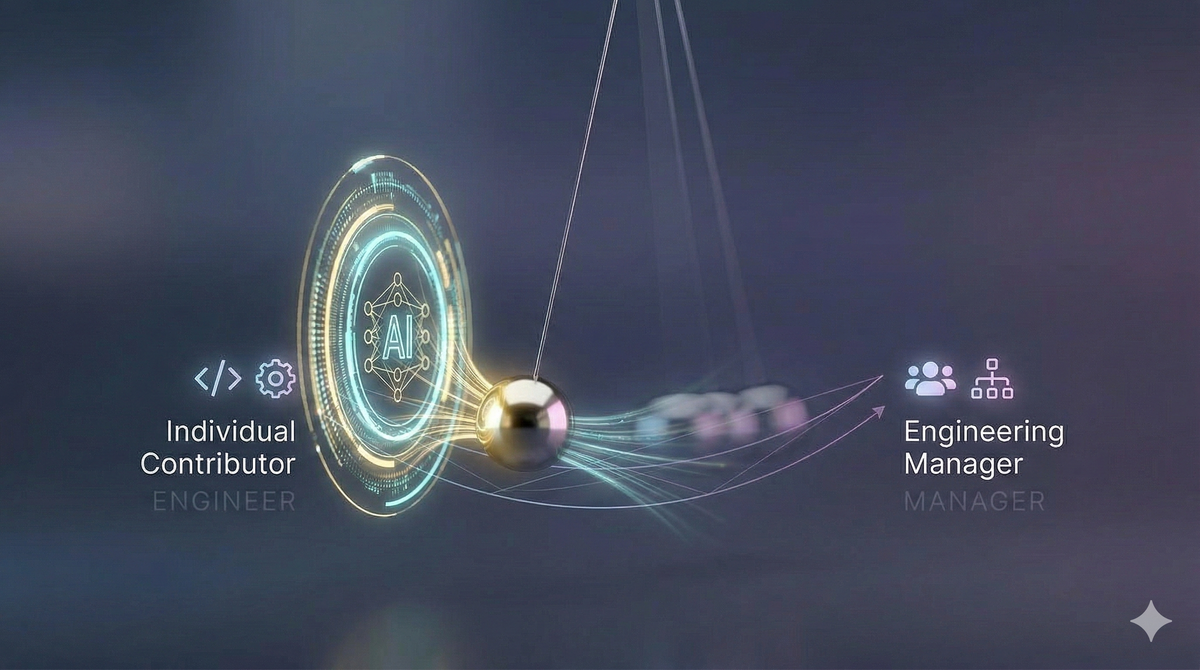
Charity Majors is the founder and CTO of Honeycomb, an observability tool for distributed systems, and I would highlight her for two things: her predilection for testing in production and her article on the "Engineer-Manager Pendulum".
In short, it has always been thought that progress in a software engineer's career meant becoming a manager. The reality is that the required skills are different, and you might simply not like that path. It’s true that for years now, many companies have offered equivalent tracks (including salary) for both the management and engineering paths. For example, there's an article by Manfred comparing various career paths in Spanish tech startups. Furthermore, progress doesn't even need to be linear. If your foundations are solid, you can go back and forth from one side to the other.
In fact, being an engineer again after having been a manager is great because now I’ve put myself in the other person's shoes; I can empathize and know how I can help them, which makes us better. Therefore, as I said at the beginning, I will probably be a manager again, but for now, I am really enjoying this stage where there are so many changes on the programming side.
Qalea
Qalea is a SaaS startup based in Barcelona that unifies cybersecurity and compliance so you can move faster, stay protected, and get certified with ease. Historically, obtaining an ISO27001 (or any other like SOC2, ENS, ISO42001...) certification has cost companies a lot of money and time. However, with Qalea, you can get certified in a few weeks while permanently raising your company's cybersecurity levels thanks to all our protection layers.
When I saw a job offer from a cybersecurity company that also wanted to focus on AI, it seemed very interesting. The surprise came when I discovered that Fran Barea was working there—a former colleague from mediasmart, a company that I don't know anyone having anything but good memories of.
I immediately wrote to him and he started telling me everything about Qalea: what he liked a lot, what he liked a little less, and all the big challenges ahead. Over time, I met Olmo, the CEO and founder, and Laura, the first employee, who is responsible for the Customer Experience team and is now also lending a hand in the product area.
We all clicked perfectly, and I joined in September, but the surprises didn't end there: a few weeks later, Yarilo, another former "mediasmarter," joined us. Of the 6 members of the engineering team, 5 of us were veterans and had some link to the rest. This week, during a 1-on-1 when I was asked what things I hoped to achieve at Qalea, one of the things I said was to continue meeting top-level people professionally and personally, because that always helps a lot in the future. Invest in networking on a personal level!
The landing was fantastic for one specific reason: on the first day, I had already met the whole team and had the platform running on my computer. I have memories of places where it takes two or three days just to stand up the infrastructure to start doing anything. Please, invest time in having an easily manageable project.
At that time, my main role was to take charge of the platform's backend as a specialist. However, after spending the first three months settling and improving the good foundations that were already there, I started working on AI projects, coinciding with the improvement and explosion of LLMs.
LLMs (IA)
What can I tell you that you don't already know about the revolution this has meant for our work? It’s one of the reasons I’m so happy to be ""coding"" right now, discovering and using the advances produced in this sector every day, even if I sometimes feel a bit overwhelmed by not being able to stay 100% up to date.
That feeling of "I'm going faster and faster, trying to maintain the quality of what's produced, but I still feel like I could go even further." We will have to find a balance at some point and fight that FOMO.
In my case, I’ve been able to work with AI in two areas. On one hand, introducing it to the team to help us with development (AGENTS.md, Rules, Skills, the Ralph method...), but the most exciting part has been creating workflows using LLMs. I created an AI workflow that generates documentation for ISO27001, saving a lot of time for clients and colleagues who now only provide inputs and then validate that the content is correct. Just today, I’m closing another project to fill out cybersecurity provider questionnaires that all our clients receive periodically, as that information is already in our systems. I’ve been able to set up a RAG using AWS Bedrock with PostgreSQL and pgvector, securely isolating each client's information.
What’s next? I’m going to set up a chatbot to serve as a copilot for all our clients and the CEx team, so they can get answers to all their questions about their data on our platform. Let's make access to information easier.
What’s coming soon? We have many ideas to grow and improve Qalea. In parallel, the team continues to grow (we are hiring!) and technological advances don't stop coming. Very exciting times ahead!